· 10 min read
I’ve been digging through a bunch of GitHub repos named ci-wk- followed by a number for a little while now. What caught my attention was my honeypot getting slammed by the IP space that GitHub actions tend to use. I found one repo, then another, and another. The same Python scripts in each repo, complete with what looked like a Telegram bot token and a recipient ID. Jackpot baby, I love me a lazy threat actor. My working theory was that somebody had gotten hold of a pile of GitHub personal access tokens, put other people’s accounts to work scanning for React2Shell, and sent whatever they found to Telegram. So the person behind it is both dumb and smart as hell. Schrödinger's skid, if you will.
I was doing a bit more digging while writing this and damnit, OpenSourceMalware beat me to the punch TODAY, November 18th! Karina Reaño had independently found 38 of these repos and brought them to OpenSourceMalware. Their researchers read the published output and found plaintext server environments. I’d been following the GitHub jobs and working backward through the accounts that ran them. Turns out we were looking at the same repos from opposite ends. Please give their write up a read, it's fantastic. (ie, better than mine here) OpenSourceMalware’s React2STEAL investigation
The action... actions
There are three files in bin/. The distinction that matters here is which computer each one runs on.
prefilter_nextjs.pyruns on the GitHub Actions worker. It goes through a batch of websites looking for signs of Next.js. Probably provided using CT logs or something, I've been seeing that a lot lately.batch_output.pytakes those candidates and probes them. One path targets React2Shell (CVE-2025-55182), which lets an unauthenticated skid run code on an affected React Server Components server. Another checks for CVE-2025-29927, a separate authorization bypass in Next.js middleware. Either path can contribute to a “vulnerable” result. React’s advisory · Next.js middleware advisoryfast_recon.jsis the part meant to run on the remote application server if code execution works. It collects the app’s process environment and sniffs around for things like database credentials, cloud keys, payment keys and AI provider keys. It even tries some of the credentials against their providers. Might as well automate that part too, right?. Of the 36 copies I checked, 12 had a later version that also returns the contents of readable configuration files.
Back on GitHub, batch_output.py sorts what came back and writes the result files. A summary can show a redacted key while the detailed output still contains the original server data. And then the workflow commits the results to its own public repo. File system databases still exist, kids.
Three seconds before the job finished
On November 17, I could line up a run in rampglobal/ci-wk-533515 with a commit in the same repo. My first pass gave me eight seconds. I’d compared the time on the commit (21:06:36 UTC) with the last update to the workflow run (21:06:44). GitHub also kept a record of the push itself. It landed at 21:06:40. The scan job finished at 21:06:43. The results made it into the public repo with three seconds to spare. GitHub’s push record · Job completion record
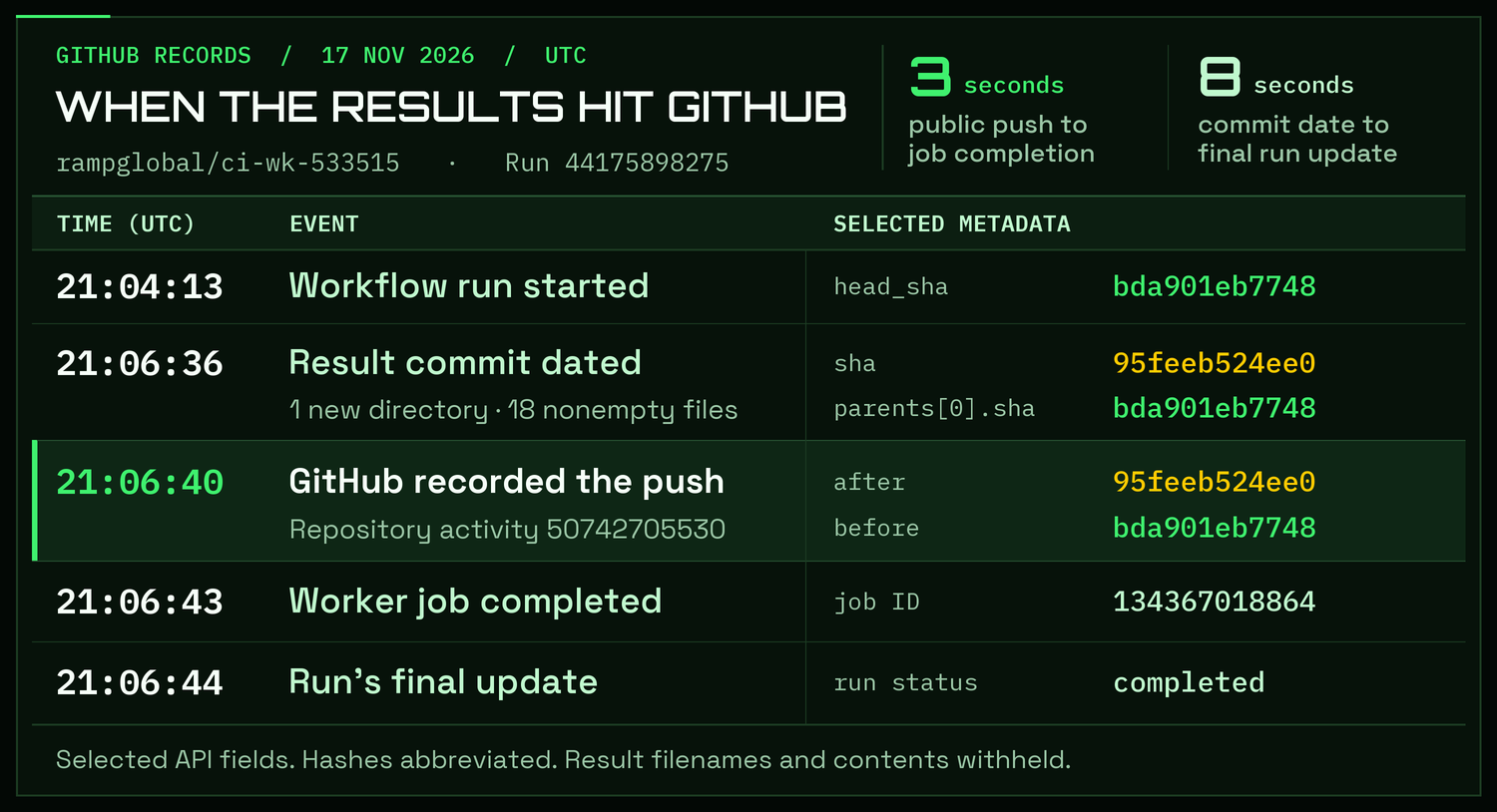
Selected fields from GitHub’s public records. Look for the same two revisions in the push. It starts at the revision the job checked out and ends at the commit that added the files.
Compare the two revisions and a new results directory appears in the child commit. It contains 18 nonempty files. I found the same parent-to-result relationship in two more runs on November 18. The author field says w, probably because he thinks he's taking a W here. Unfortunately, he kind of is. The workflow sets that "name" itself. November 17 run · Commit metadata · November 18 run · Its commit
I counted 22,454 timestamped results directories across 31 repos. One site can show up repeatedly, in several formats, on several runs. I used Git’s file metadata for that count. I didn’t open anyone’s environment dump or try their keys because I'm a skid buster, not a skid. OpenSourceMalware examined the latest results from 34 repos and counted 1,281 distinct hostnames across roughly 1,100 domains. They found database connection strings, payment and AI provider keys, and other server configuration sitting in plaintext. Anyone with read access to those public commits could have seen it. OpenSourceMalware’s findings
So what about the bot? The uploader in batch_output.py is off by default. I checked both current versions of the workflow and all five distinct versions I could recover from the original repos’ default-branch histories. None switched it on. I even had the “channel” part wrong. The recipient number is in Telegram’s range for a private conversation with a user. A delivery receipt or a successful Telegram upload response tied to a particular job would settle whether a file got through. Telegram’s dialog ID reference
Bruh, how many repos?
By the time this popped onto my radar, some of the workers had been around for a few weeks. I matched the source files, checked the creation times and used GitHub’s numeric repository IDs to keep the count straight.
| Created in 2026 | Matching code recovered | Historical records only | Total |
|---|---|---|---|
| October 22 | 24 | 7 | 31 |
| November 11 | 7 | 3 | 10 |
| November 14 | 5 | 0 | 5 |
| Total | 36 | 10 | 46 |
That’s 46 repos under 45 account names, 13 more repos than I started with. Each Python file had the same Git blob ID in all 36 code-matched repos. For the other ten I have IDs, archived activity and creation times that fit the bursts, but no source to inspect. All 45 repos in OpenSourceMalware’s catalog are in that 46. The one extra, sysibase/ci-wk-108914, is one of the historical leads. OpenSourceMalware’s campaign catalog · Historical repository record
Five repos share the November 11 creation time of 04:15:41 UTC. I could still check the code in four of them. The fifth survives beyond the grave in the historical records. On November 17, all 31 code-matched repos with a scan run on record had a commit labeled chunk dated between 21:04:03 and 21:04:12 UTC. Nine seconds from the first commit timestamp to the last. GitHub commit records for that interval
By my final November 18 snapshot, GitHub had recorded 25,623 scan runs across those 31 repos. The five November 14 copies had the kit and input ready to go. All five showed zero runs.
I went looking for repo number 47 by working backward from 6,016 account names linked to GhostAction or wfx-loot, including leads but I didn’t find it (skissue). The earliest scanner I can date is still DITISOKOLI/ci-wk-34751, created October 22 at 02:05:52 UTC. Threat Intelligence NZ documented the October 22 and November 11 waves on November 16. They put possible development as far back as September based on clues in the tooling. First repository record · Threat Intelligence NZ’s November 16 post
All 504 hourly GH Archive files for October 1–21 came up empty for the exact repo naming pattern. That’s more than 25 million public events. I also checked the files at 163 earlier revisions in case the scanner was around under a different name. No matches there either. A good measure of how much GitHub history can disappear from view is that the historical name index missed six of the repos I already had. GH Archive
I think some sneaky rat had GitHub tokens
GitHub lists the repo owner as the triggering actor on all 299 scan dispatches I sampled and that tells me which account GitHub saw from whatever source (foreshadowing). To get any closer to how somebody got access to it, I needed to look at what that account was doing before its scanner showed up.
Take seagal1125. On October 8 at 14:57:22 UTC, GitHub recorded that login pushing a GhostAction-linked workflow to an older finance project. Two seconds later GitHub recorded a run at that commit, and the run succeeded. The workflow searched repository history for classic and fine-grained GitHub personal access tokens (PATs). On October 16 the same login pushed a fake font and an editor task matching published GhostAction file hashes. Its scanner appeared October 22 at 02:12:21. The first wfx-loot probe I found from that account came on November 10. October 8 run · GhostAction fake-font research · Scanner creation record · November probe
I found GhostAction-linked workflow pushes in 140 older repos under six accounts that later hosted scanners. In 130 repos the workflow was an exact match for the known PAT hunter. GitHub marked 108 runs of that version successful across 107 repos under four of the accounts. That’s a pretty good reason to take stolen PATs seriously. A job can finish successfully with nothing to steal, though. And whoever planted the first workflow already had some way to write to the repo. I can show the hunt for tokens buuut I can’t trace a recovered token into the creation of a scanner.
Where wfx-loot fits
wfx-loot was after secrets available to builds in GitHub projects. React2STEAL used GitHub builds to go after secrets on other people’s web servers. When some of the same account names turned up in both, I wanted to know which came first.
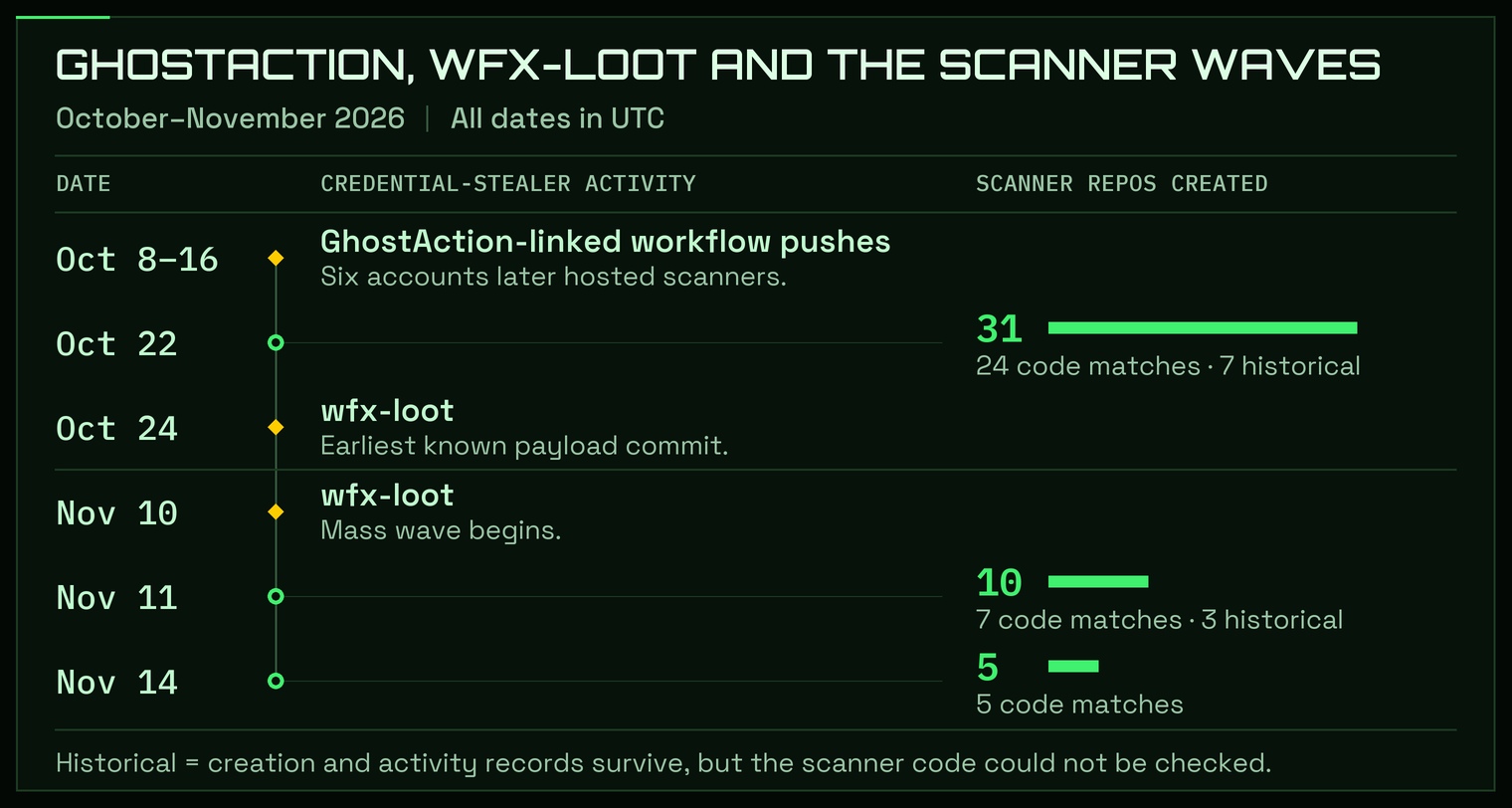
Almost 46 hours separate the first scanner from GitGuardian’s earliest known wfx-loot payload. By the time the next ten scanner repos appeared, the wfx-loot mass wave was underway.
GitGuardian dates the earliest known wfx-loot payload to October 24 at 00:05 UTC, nearly two days after the first scanner and its mass wave started November 10. I found 162 wfx-loot probe pull requests opened by 27 scanner owners and verified the file each probe added. Two more owners appear in archived pull request events with the characteristic branch name. That makes 29 of 45 owners with some evidence of overlap. For six, the first wfx-loot activity I found preceded their scanner. For the other 23, the scanner came first. GitGuardian’s wfx-loot timeline
Two of the November accounts, TBWISK and haoyongchun1125-maker, left a better trail than a probe. Before their scanners appeared, GitHub recorded 257 pushes with the commit title ci: refresh build cache and 257 with ci: restore under those logins across 32 older projects. I compared one pair of pushes per project. In all 32 cases the second push put the original tree back, 46 to 52 seconds after the first. Four of the inserted workflows I inspected contained wfx-loot markers. I found no surviving run in those windows to show the inserted code executed. Both logins had already pushed GhostAction-linked files on October 8. Reusing access somebody already had fits that sequence just fine. Push records for the 52-second pair · Workflow change under TBWISK · Workflow change under haoyongchun1125-maker
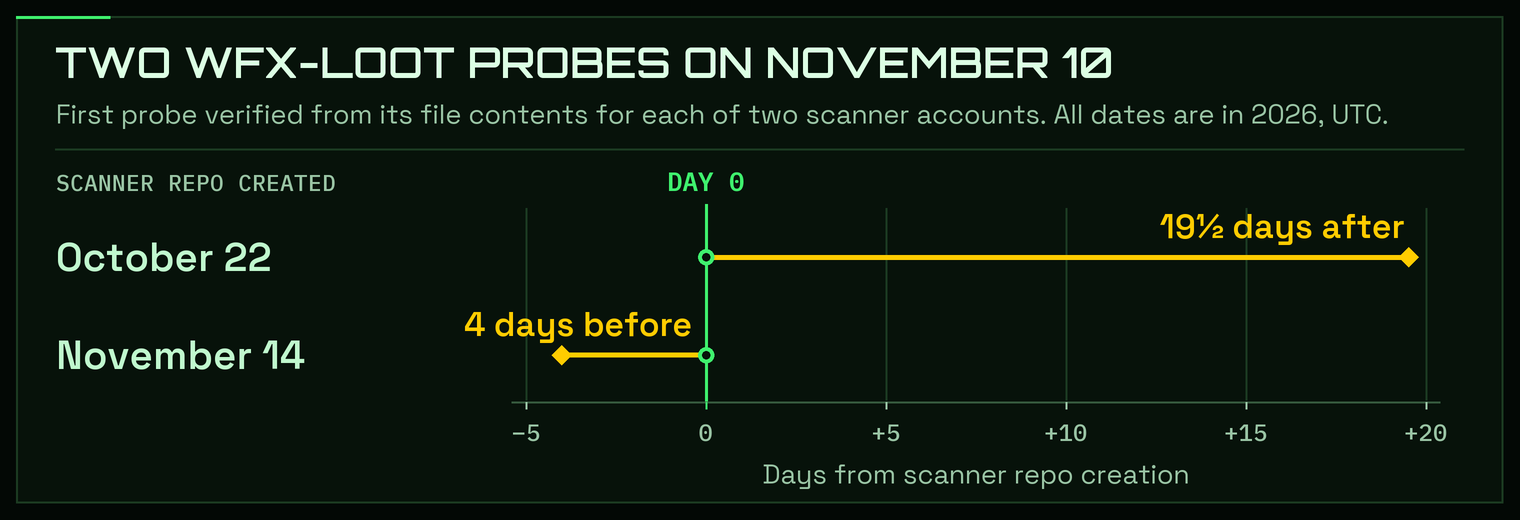
Both logins opened a wfx-loot probe on November 10. Put each one next to its own worker’s creation date and the order flips. GitHub identifies the login that opened each pull request. The credential used to create either worker is still an open question. November account’s probe · Its scanner creation record
My guess is that somebody reused access to existing accounts. The overlap doesn’t tell me how many people had that access. Even the Telegram bot and recipient in the wfx-loot samples I checked differ from the ones in the scanner.
Stolen PATs are my leading guess for at least part of the fleet. A stolen session or OAuth grant also fits but I'd bet a few hamburgers on PATs. In a separate wfx-loot case a maintainer identified a leaked GitHub CLI OAuth token. The public pull request had the same empty app-attribution field I saw in this batch. For the later result commits, both workflow versions requested write access for the built-in GitHub token. That could explain the result pushes. GitHub issues the token when the job starts. Someone still had to create the repo. Maintainer’s account of the OAuth leak · GitHub’s workflow token documentation
If you’re looking through your own logs
For a GitHub owner who found an unexpected worker, I’d start with the repo creation event and the first workflow write. Save the numeric repo ID and the UTC times. If your audit logs include the credential type and token fingerprint, compare those fields with the earlier pushes under the same login. That’s the record I’d most like to see for the PAT question. For matching old revisions in your own repos, the two Python files had these Git blob IDs. GitHub’s guide to tracing access tokens in audit logs
| File | Git blob ID |
|---|---|
bin/batch_output.py | f326b930694339c3dd7a8605c41e76e8bbb15255 |
bin/prefilter_nextjs.py | 6c0e38cc4ef9a863bb5ae2ecaa63162646bccb1a |
If it’s your web app that showed up, a hostname in a target list tells you where to start looking. Check which version was deployed at the time, then line up the inbound requests with the app’s logs and the audit or billing history for the keys it could read. If your environment data made it into a public commit, patch the affected deployment and rotate the exposed credentials. GitHub taking down a repo doesn’t change your database password or repair public perception.